28 December 2009

A Debate

My friend Peri and I have had debate going on for awhile about the virtues of night people verses morning people. Though not really an argument, it made me wonder why some people tend to have loyalty to a time of day. I've long been telling friends that my least favorite time of day is noon, or whenever the sun is highest. I have no idea why--I think it may have something to do with the fact that color seems to me to be at its most washed out in the full, shadowless sun. There are exceptions, but as a general rule, I like the hours of transition best, when the light is moving, and most of all, the hour then the sun is rising. I have some friends who call the hour before sunset "the golden hour" because of the quality of light at that time in the mountains. They usually choose this hour to drink wine. What a good tradition! I remember when I was in high school seeing their mom in the front yard of their house, standing undeneath a tree with a glass of red, her hair caught in gold. I could go on, but let me just say that for me, to be walking around Edinburgh when the first orange light is hitting the rooftops and the towers is something else. Only the sea gulls stick around this time of year, and there's nothing to be heard but their high-up cries and the labored engines of the buses. I walk in the gardens and the sun comes up behind the huge bank building and the houses along the Mile. It leads almost inevitably to prayer.
        Anyway, the time difference between here and St. Louis provided Peri and I with a unique moment the other day. I was up pre-dawn, when the horizon was grey, and I noticed she was logged on to Skype. She was up, it being 2:30 am her time. So when we spoke, we were both at our prime hours. Our hair was messy, and we talked about books and Dani and distance. It was almost like time-travel. I've never been so struck by the wonders of the information age--go humans: I can be up late and up early at the same time.
        This, of course, generated a poem, into which the corn field behind Dani's parent's house in Michigan somehow also sneaked. See what you think.

Quiet Table
for Peri

Those who love night
and who love morning
love the same thing:
the silence that is heaped
on the edges
of the day,

the snow turned aside
by long hours of speaking.
And in the house, the table
with its blue cloth—or is
it winter light? where they sit
listening, sure that their parents sat here

before doing the same. Or are they my parents,
and am I listening? Still, there’s
always the table with a cup
barely warm, and ashes
in a dish that are the same
as worry and time.

There, whoever it is
that’s listening has to decide
if the snow is clean
or blackened, and what,
out of all this speaking,
we have made.

And does it compare with
the calm of a blue field
untroubled by the sun,
and the deer printing
from the woods on its east,
carefully, to those on its west?

picture: http://images-3.redbubble.net/img/art/size:large/view:main/2858013-2-empty-coffee-cup.jpg

22 December 2009

Snow, my Thankfulness


I've been guilty lately of mono-media blogging. It doesn't seem like a stretch to believe that you'd like to discover more from this site about our lives here than you can get through my poems. Although I hope you've enjoyed them. This picture was taken from our window this morning. The past five or six days have looked about like this, something that the neighbors tell us is impossibly rare. There have been snowball fights, fallings down on the pavement, and lots of immature staring out the window while my wife was trying to tell me something. But she is from Michigan. I never get to see this kind of thing.
   I've written a few poems about snow falling through the light of street lamps. I've spent a few lazy days reading Lord of the Rings, as is my dork-custom at Christmas. Dani goes to work and comes back and we both smile. In the evenings, we walk the city (brighter than usual in the snow), and at one point wandered into the Princes Street Gardens, where we ice skated--or actually, she skated and I fell down a lot and grumbled about being pigeon-toed, which is not, really, the reason I am so bad at it. We've acquired a niece. I have breakfasted at the Two Thin Laddies, my favorite new coffee shop here in Tollcross, our little nook of Edinburgh. I have poked around the local bookstore. I have been absolutely useless to society. A waste of espresso and Dani's hard-earned money. That might be her big Christmas gift to me. And yet she has crammed the space beneath our little tree with what I'm sure are tasteful and generous gifts. As usual, I am able only to write a poem in response.

Snow shaking through the wash
of a street light. The way
words catch and don't catch
how a woman makes me feel.

The way she dances at the edge
of tongue and eye, because
whatever's moving her
is also moving them.

The snow is borne upwards again,
and goes to sleep finally
on the bald head of the mountain.
Walking in the morning, I see it,

and know how old man is, and yet
how young the earth, time,
and words, so that if I apply even
this well-hewn craft of speech,

attempting to say "her,"
it may as well be mute man
slamming rock on rock, trying
to give birth to thunder.

18 December 2009

Giving Up

It was hard to stop not due
to the science of nicotine ingestion,
but because of the smoke hanging
over the Chattanooga I remember,

that clings elegantly over its river
in evening. A birthday party,
beer rings on pizza house tables,
a small wetness of street dew

in the bends of a good shirt.
It was difficult to stop,
because I couldn’t bang or tap
out the residue of a few faces,

because their ashes refused to clear
in the wind even of another country.
In that burnt flavor, there
is something of those over-

spent nights, wearing out
guitar strings. Something
of the slow, artful
southern dawn.

Haiku #1

Snow in this city.
A white bird settling on
a black Rowan branch.

A Snowy Room

I came there on an errand
they weren’t ready for,
and had to wait.

And they put me in a room
where I could watch the snow
hushing the local rooftops.

And I realized it was all
I wanted: a snowy room
to walk around in,

a quiet room, the hot
cup they handed me,
some time.

What I Remember

A wooden chair in the path of the leaves.
That was the last of November’s trees.

13 December 2009

Poem with Merry Leigh in It

The brown rings of my sister’s curls
catch and toss green light around
from the lamp that hangs outside
the Green Light Café. We are already

on our way. To what or where?
Between icicle-light buildings,
a giant Christmas star clings
to our town’s only telephone tower.

We cross the street without looking.
Her air of disapproval as I fill
the chilled air with buttery
pipe smoke. She straightens her

pink jacket. Amazing, how I can live
in a memory having lost its
destination. Who threw the party we
were angling towards through neighborhoods?

Had she bought the scarf new
she snagged on the bare hanging
sticks of a poplar? I feel
we didn’t stay for long,

but I still remember the heart-snag
of anticipation, seeing chimney smoke
carried sausage and cider-scented from the house,
the slatted light on the yard we entered.

Mounting the porch by an anonymous
staircase, I pass out of my own mind’s grasp.
And it only makes the party sweeter, that I
possess nothing fully, not even myself.

Walking Through Morningside

The cigarette-butt moon has put herself
behind the mountain. A strange string of silver,
its ridgeline endures the meteor,
and sinks thunderstruck into the city.
The park I’m walking through is narrowing.
Soon all that’s left is a pavement path
on a stripe of grass. And ahead, the coals
of shop windows have been raked to fire.
My walk is funneled there, to a silent fair.
A franchise coffee shop is the first to stick
her leg out at me—the aroma of my
sustaining mistress, espresso. But no time.
Impossible though, not to look in the windows.
This one selling tea time, this
one selling books and puppets, this one
little pre-snowed Christmas trees,
this one selling ashtrays for the moon.
This pea coat is rumored to be lined
with Merlin-fabric that sparkles starlike,
this chair will turn your ass into a king.
Georgian house fronts on either side
are the tall frozen waves of time. Here
below bustle the permanent phantoms
of the enticements I’ve grown up
walking through. That’s their wizardry,
that to me they are as old as milk,
though these days, not my destination.
But for what brief and vital moments, on my way,
have I been convinced of what they claim—
that these merchants have brought down, and
now sell, piece by piece, the heavenlies?

01 December 2009

December 1st

Nothing new to say to the frost.
The smoky tea I’m drinking in its honor
is the usual toast.

And the chipped-ice gulls
that scrape through sun and shadows
out there in the Meadows

say with me again, “You’re back to speak
that soft ‘don’t worry’ over all we’ve done,”
and my eyes cross the hardened grass

with them, until I receive the gift:
a white-breathed stillness in my brain,
the quiet of a finished year.

29 November 2009

Cafe Midwife

They slept keeping a light on in the back,
each tired refrigerator murmuring,
a child’s mouth speaking out of dreams
about the past day’s ramblings.

And when their aproned shopkeeper comes in,
to rouse each with the smell of coffee steam,
they light up like thoughts out of a smoky place
where memories live, cold and beyond our reach.

Beyond that hill, seen by a bustling girl
dressed in a waiter’s black, the patient lava
of every morning boils, a quiet orange.
Flushed and just showered, yesterdays’ orphaned daughter,

shouldering her purse. Slipping through the door
to wake the café’s present, she’s content.
Her events are rising like well-cooked bread,
the sun crawls in as if by her consent.

24 November 2009

Jack

Mom’s cold hands putting laundry on the line
on a November morning. Or that cold wreck,
the rained on frame of a rust-yellow bus
that sleeps like a bull’s back beside the road.
Or those few mornings in December, when
the impatient torrent which sees an Autumn pass
is soothed, and fields hang bare in a still sun.
Yes, all your children know me well. I often
freeze the grounded butterflies of their
last dreams, and chill them into wakefulness.
Your elderly recall me in their bones,
because I await them there, sleeping like
a sparkle on the grass that no new dawn
will ever melt. In you I’m just a tone,
an attitude, a chilliness of speech
that reeks of unconcern, but sometimes breaks
like light through a hoar gray mess of branches,
puncturing your mind with soft emotions
unearthed by some small tenderness your wife
comes out with like an apple pulled shining
from a pile of moldy leaves. Then, perhaps,
you drive to work, beneath the handsome brick
of many country bridges and past the wonders
of simple meadows you so often fail
to really recognize, smiling a bit,
but with a quivering in your depths that feels
like birch-gold barely clinging to a branch,
because you know where all my patient lessons
end: the churchyard with its frosted stones.

18 November 2009

Memory

for Luke

In what light did you cross the bridge that leads
to Coolidge Park? Some luster of near-evening,
where you could skirt the limits of what flees
from recollection? What party were you leaving?
Your slouched walk echoed on the plankwork. You
were thinking little boats of thought along
the bubbling Tennessee. Behind your view,
a man scooped from a black piano song
after black song. His house, the riverbed,
the music, rolled below. In that suspension,
and loosening your tie, you grasped backwards
at what a girl in hip-slung sash had said.
These few things we can keep, blessed apparitions,
can make such grand, bright structures out of lack.

13 November 2009

Strip Clubs

Especially on weekends, patrons wrapped and sunglassed slink through doors that seep out fog,
shielding us, or themselves shielded from
identity beneath the neon. “Lap

Dancing” and what other faceless glees
that murmur promises inside the walls
are advertised, and always draw a throng.
They laugh like kids reentering the streets.

Coming home, my wife and I witness
their cigarettes on every corner of
the block, bobbing up from hand to lips
like boat-lights on a sea that’s stormed and restless.

What interchange of souls occurred in there?
What burning thing changed hands? For always, when
they come back out, a grave lightheartedness
is on their faces. Like a brand, they wear

the mark of a timultuous encounter.
I wonder, is the guilt of my temptation
projected on those stubbly chins, as if
I’d gladly follow them, denouncing her?

Now this or that man takes his glasses off.
The grace that makes a gulf between us also
reveals to me our fateful symmetry:
sins dancing in the mirrors of my thought.

11.13.09

A Roadmap

As you all know by now, I'm crummy at blogging. However, there has been writing going on in the background, I'm turning this into a posting board for all of it. This will give you at least some sense of my experience and environment. You'll notice trees--these are the trees in The Meadows, the local park through which I walk to the University. Sorry for that preoccuption. They are a big part of the mental landscape. Anyway, more to come.

Mythologies

The trees undress, and start their yearly shivers
harrowed, flailing, by a pack of crows
that chases each into its fixed adventures,
anchored to the ground, where row by row
they undergo a parable: without
their armor, sparring with the wind.
The path between them, garbage smeared around
them, daily runners jostling out and in,
sending up frail plumes of breath as white
as thought that wears no language. What’s been fought
by branch and drop and bark above them writhes
and symbols truth by nothing so precise
as words. Though often, like a morning fraught
with birds, trees haunt the sky with mythologies.

11.12.09

Izzy

Girl chasing white dog:
the speckled bullet of her “Izzy”
is a suggestion of movement in the wet trees,

a stain on the pure conscience
of their forest of unbroken black.
The sunset dwindles into a ghostly mistake of light.

It its last redness, her call flutters out
like a bird’s. She’s muddying her shoes
into the woods behind him, still he’s running,

he doesn’t hear. He has something
to rouse beyond her pity
in the tree-dark wildness of himself.

11.4.09

This Tree

This tree a harbor,
full of frail yellow fishers
constantly overturning, moored
for the summer and always
sailing out forever.
Tonight the ships are burning.

10.28.09

My Pen No Paintbrush

North Bridge would be bubbling light,
an expressionistic motion of busses,
lampposts like black trees crowned with
Caledonian fire, tall columns and clock faces
vandalized by a Peter Pan recklessness of light.

Having begun with the creamy, crested underbelly
of a hotel terrace, a fine motion,
then constructing dark implications of architecture above,
and leaving the mountains behind nothing more
than a vagueness of craggy greens.
All of this to stage the glow that conveys my emotions,

truly, like an embrace.
But I am possessed of no studio, a wordy
black ink my only medium, the scratch of
pen to page a tune that tires the ears.
And in my mind the desire of a wet city,
throbbing to be made shapely by the mind’s eye.

10.27.09

Royal Mile, Cold Evening

The sky pink and gray from crying,
the street awash with characters,
hurrying, jacketed. No medium sufficient
for them, no long enough stretch of white page.

The drizzle turning to sleet-drizzle,
the gimmicky tea-houses swelling
light suggestively into the dim
matrices of the streets. Car horn, then silence.

A woman with pink eyeliner, lead by
her elbow by an earnest-looking man,
is sobbing at embarrassing volume.
They disappear into a bright door that shuts.

An executive of some old forgotten school
of gentlemanly banking, with white hair
bundled around his collar, opens an umbrella,
looking across the street with clear-

eyed confidence. Such orbs unto themselves.
Such curved globes of held complexities.
Not far below, two children in black
shamelessly kiss in the wet grass of the park,

under half-stripped trees that mull to themselves
gently on detached thoughts. Somewhere
wine glasses touch. Somewhere else a pigeon
startles onto air, scattering drops and moltage.

The Peter-Pan house fronts age from gray-pink
to red-gray, a bell jars out, announcing
the implausible time. So dark already?
So dark, yes, and so much lost tonight to art.

10.26.09

At the Gathering Place

I see a man with half a hand, typing at a kind of limp in
the Elephant coffee shop. The lacquered table
gleams malformity back at him.

His un-hand fitting strangely in
the ring of a cup handle, yet such a
calm normal face. The steam rising to
it playful, like an exaltation

of morning. It would be easy
to say there’s no Christ here to
heal him, easier still that
he needed no healing. Green jacket

bunched around his neck and hunched
shoulders, typing excited now,
in reply, perhaps, to a lover.
The warm blue glow on his face.

But raising my head I see the windows full of shaky light,
the little regiments of salts and peppers on every table,
a woman in green gloves. All so full of an Image
neither of us can rightly grasp.

10.22.09

Park Music

Take a few tunes in the street
to comfort you. Past a leaning light, into the dusky luminous grass,
voyage by footpaths into your unknown self.

By this tune, craft to pure light that
boy with girlish features you’ve seen,
bless to weightlessness the flight of rooks
fished from the sky by a worm’s wriggle.

As they descend like shaken bells in unmediated
music, catch an angle of meaning, like
the weight of a late fruit making a branch bend.
Go out in the park, open up your hand.

10.20.09

Things of the Field

There is delight in being nowhere else.
The fullness of the present is pollinated
by the absence of all other moments.

The house crisp with the scent of apples.
A friend saying over the phone that she
could adore a world where nothing survived but trees.

Beside the bike path, beneath taffy skies,
they hang heavy with no memories at all,
and racing below them, passing through and

scattering leaves already cheese-brown and slick,
does she escape, gliding, with a kernel of inexorable knowledge?
The spokes chime—gears changing—and even the question glides off unformed,

a fast wink of red.  
 
10.09

Almost Verses

There was a moment of unretainable
silence. The light paused, a girl

walked her Dalmatian, and I heard
the tinkle of its collar a hundred yards away.

There was long lifting of trees. The orange
fire of oaks, shingling the world in fine beauty

they choose so easily to forget. A golden-bellied
bird chased its song around in a dark bush.

And I thought of all the song, the half-born praise
in me, Lord, that you somehow keep for yourself.

10.09

Traveling Backwards

Be careful enough with that inner eye,
and it won't take long. The berries on hollies
brighten into health, the last mourning doves sink
through thickets into silence. Someone
is chattering in the light of a stove.
Someone is burning sweet potatoes. The house
grows plump with the hot scent of cider:
the holiday strikes the place into a glow.

The yard, not long cleared of the walnut tree's
sour green unloadings, is as still as a shed
feather on a windless day, and soon
they will arrive, smelling of unbrushed hair,
tweed and car interiors, to disturb and enrich
the children on various levels of themselves.
Careful enough, and you'll remember you were
a little one, full of cookies and uncurbed desires.

The wreath of bells on the door jangles whenever someone
comes or goes. In the evening, wooded symphonies
entirely the percussion section of branch-clicks,
the looming pre-snow bite of air. Careful enough,
and you will be there, all your senses,
with nothing in your mind but a pine fire
keeping long watches with your father, inhabiting your
sleep as this wanting to go back now haunts your waking.

10.26.09

29 September 2009

Castle Watch


   Not two weeks in and, having read a little of Ted Hughes' Birthday Letters, I'm subject to a nagging fear that my Edinburgh is actually an American one. No civilization on earth, except arguably for Rome, has had more of a talent for projecting our culture onto that of other people's. Every day, perhaps, my wife and I walk down an airy side street next to a graveyard, overhung with birches that are just getting gold at the edges, at the black feet of the castle rock, through our own little pretend America. Or maybe I'm just overreacting to getting the Internet in our flat and going to the theatre last night to see Fame, which is the visual equivalent of drinking thirty Coca-Colas in the middle of Time Square.  
   The only thing that reassures me is the unstoppable tenacity of Scottish culture. For those of you who think Shakespeare has always been called "The Bard", understand now that that is Burns' title, and his poems are on the five-pound note. There is Scottish poetry written on the walls of the most seedy, illiterate pubs. They actually took the time to translate Winnie the Pooh into Scots. The preservation of their accent in a globalized culture is a kind of national institution in Scotland. And there is something very fresh about being in a country that has just gotten back its parliament, where street vandals spray-paint to walls "End London Rule", which is a sort of admirable sentiment, as opposed to adding "War" to the end of stop signs, which isn't really. What they call the Scottish Renaissance happened within the last seventy years, and everywhere, especially here in the capital, there is a feeling of national emergence propelled by art.
   Tonight there is smoke rising softly from one of the chimneys of the castle. This is the first time I've seen it--a recent indian summer has given way to the more seasonable wet and cold, and apparently some custodian is feeling chilly. By night they light the walls of the flat, southerly face of it, and occasionally, as if it weren't already enormously imposing, shine spotlights up and out into the fog. It actually illuminates our living room at night. On the street the tenants of the local strip joints yell at each other, and sometimes us, if we get back late enough, and make us shiver. Black rock and cigarettes are everywhere.
   If you've looked up Patrick Wolf, great. You either trust or distrust my tastes now. Whatever you decided, picture me listening to "Teignmouth" walking to school amongst the ugly high rises, which run right up to the edge of the golden-grassed hills at Holyrood park. The landscape is so dramatic as to be forceful--we'll see what it does to us.
  I'll let you know if anything moves at the castle. So far, only steady steam and the gull's cries.

16 September 2009

Patrick Wolf

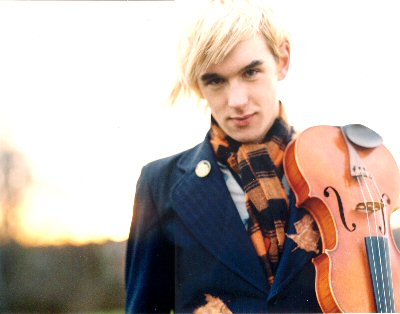
    Patrick Wolf is a flamboyant artist with an umbilical connection to London, who has managed to channel the spirit of the English Romantics to express the struggles of the modern bisexual generation.  The picture posted here is of Patrick at his most tame--other photos you might look up display him dressed up as airplanes, decked out in his signature "vulture cape," or strapped into S&M regalia. But letting his propensity for the shock factor scare you away would mean a definite loss--in his body of work, he is accomplishing something of literary proportions. 
   His music, which combines virtuoso singing, orchestration and instrumental

performances with electronic pop elements, somehow manages to come off sounding honest every time. His lyrics are charged with literary energy. Picking up on poetic images, like the reputation of magpies as thieves, he molds highly lyrical content, without any apparent effort, to his own original ends ("Magpie, was it you who stole the wedding ring? Or what other thieving bird would steal such hope away?").
    Wolf's second and third albums, "The Wind in the Wires" and "The Magic Position" represent him at his best. Plucked out of the London masses at a very young age, he was set up with mixing and recording equipment, and not long afterwords produced "Lycanthropy," which I think of as mostly juvenalia, but which set the stage for two undertakings that combine absolutely state-of-the-art mixing with world-class orchestration, almost all of which was recorded by Wolf himself. Indie fans might be interested to hear that his violin talents have been put to use by The Arcade Fire numerous times.
    The real genius of his work is his sensitivity to the lyric--like Shelly or Byron, he sets himself up as a kind of genius solitary, a wander and outcast whose rebellion against norms is a source of enlightenment. This strategy molds excellently to his own cause--the "satanist school" of the Romantics is morphed into a "transsexual school" of lyrical music which makes similar use of lonely contemplation, outdoor images, and, of course, shock value. Once Shelly denounced both Heaven and Hell in his epic, "Alastor," now Wolf seems to denounce sexual norms with equivalent flair and vibrato: "In the same way I don't know if my sixth album is going to be a death-metal record or children's pop," he said in an interview with The London Paper, "I don't know whether I'm destined to live my life with a horse, a woman or a man. It makes life easier." It's hard to imagine how that could make life easier at all, but Wolf's stance remains lucid. The confusion and rage he feels as a result of this stance is evident all over his work, and seems to have pushed him over the edge in his latest album, "The Bachelor," which is a descent into hammering, unpleasant techno-rock that I think displays all of his worst qualities and few if any of his best.
   One of my favorites of his is called "Magpie" (From "The Magic Position") a haunted piano piece in which a young boy lost in a sexual "hinterland" questions and is answered by a wise, thieving bird, who has stolen his wedding ring from him, a symbol of definitive sexual identity. Though he is often disagreeable and purposefully grating in interviews, in his best music you will fund lush, extravagant style that echoes something of Wilde in addition to everything else: Wolf's obsession with beauty is obvious, and in his highest moments he achieves the clearest, most winning expressions of sexual struggle produced by our generation. Similarly to Wilde's "The Love that Dare Not Speak its Name," his work tries to convince us of its rightness by virtue of its beauty, and almost does it. 


   Here's a great live version of "Magpie" http://www.youtube.com/watch?v=Y2tnRR6FJ5U


21 August 2009

Introduction

The girl with a far too-obvious perm is leaning in the warm light under a ceiling fan, against a shelf lined with bags of coffee. The paint on the windowsill is flakey, the conversations bud up to a strange volume then die away, uncovering the click of dishes being washed in the back kitchen of the coffee house. Someone is arguing with the cashier. Someone is confessing. A batch of green vines are bobbing in the wind along wrought-iron railings just outside, in the last of summer in Chattanooga. Here, like an invocation, a poem or a song comes back to me, addressing my needs. I open a book or call something to mind, during a few minutes when my wife is checking her email, and I find myself spoken to. An outside party has ventured in. A warm hand has rested on my shoulder or slapped my back. I’m full as if after a good meal. Art dignifies and enriches life. Mostly, this happens via language.
I’ll make my opinion on this clear from the start: words work in service of something. They do not possess the kind of power they do over us because they only reveal and re-articulate ourselves. To Czeslaw Milosz, all words were a silence leading up to the one grand Word that comes to us after death, answering all the questions of mortality. That Word, the saving Word, is spoken by a person, and one whose speaking is a greater mystery and wonder then all the good poetry poets have ever conjured up.
But all the same words are a gift exchanged by people to people. Anyone who has ever read aloud the last lines of Frost’s Stopping By Woods on a Snowy Evening knows the undeniable satisfaction of his conclusion:
“The woods are lovely, dark and deep,
But I have promises to keep,
And miles to go before I sleep,
and miles to go before I sleep.”
    There is no telling what long journeys, physical or otherwise, that poem has helped its readers cope with. Frost’s almost audible sigh, his acceptance of the bleakness of the moment, is better than a platitude, or even piece of clear advice. It puts a name on something we have felt, and that action by itself pleases us. I once listened to an audio show titled “Can Poetry Matter?,” a question that brought real laughter to my lips because to those of us who read and enjoy poetry, that is the same as asking if life can matter. What good art brings to us is the experience of being. We can instantly recognize bad art because it doesn’t taste of living in the world. It’s functions and aspirations are as many and as various as ours, but what it returns to us is what we have already put in to life: exhaustion, tears, sex, prayers, anger and long walks, giddiness and boredom, work, lies, my evening in a coffee shop, etc. etc.
    This place is a wall upon which I will scratch remembrances of that which enriches. To lay a few parameters, I hope that it will always be related to my personal experiences as well as to that which enhances those experiences. Another way to say this would be to say that here I will list the things that remind me of the speaker of that saving Word. You might say that I hope all the words here will rhyme with that one. Part of the way I will seek to understand my own ideas will be to investigate the ideas of others. There's no reason not to start now. As a note, I'm not ashamed of my bias for poetry, but will try to swerve away from time to time for the sake of freshness. 

    Robert Hass, former U.S. Poet Laureate, and long-time host of Berkeley’s Lunch Poems, for which well-known contemporary poets gather in a room at Berkeley college lined with books, and spend an hour or so doing readings (you can see his own contribution to the series at http://www.youtube.com/watch?v=DJCbwBnHFbg), thinks of poetry as the praise of the indescribable in life. Bruce Bond wrote an excellent essay on his work entitled “The Abundance of Lack,” where he describes Hass as extremely perceptive of the failure of language to fit in all of life. To Hass, language is not the running beast, but its footprint, and it delights us because it perpetuates desire to see the beast itself.
    One of my favorites of his, from his most recent collection, Time and Materials, is called “That Music.” Like all of his best work, it is georgeous in its simplicity. When spoken aloud, each of his words lends a beauty to the next which makes any of them seem scrumptious enough to be enjoyed all on its own. Playing on the tension that Bond describes between what words do and what we know they cannot, this little poem ends on an unresolved note of wonder fueled by longing. It would be Hass’s argument that the one can’t exist without the other.

That Music

The creek's silver in the sun of almost August,
And bright dry air, and last runnels of snowmelt,
Percolating through the roots of mountain grasses
Vinegar weed, golden smoke, or meadow rust,

Do they confer, do the lover's bodies
In the summer dusk, his breath, her sleeping face,
Confer--, does the slow breeze in the pines?
If you were the interpreter, if that were your task.