29 September 2009

Castle Watch


   Not two weeks in and, having read a little of Ted Hughes' Birthday Letters, I'm subject to a nagging fear that my Edinburgh is actually an American one. No civilization on earth, except arguably for Rome, has had more of a talent for projecting our culture onto that of other people's. Every day, perhaps, my wife and I walk down an airy side street next to a graveyard, overhung with birches that are just getting gold at the edges, at the black feet of the castle rock, through our own little pretend America. Or maybe I'm just overreacting to getting the Internet in our flat and going to the theatre last night to see Fame, which is the visual equivalent of drinking thirty Coca-Colas in the middle of Time Square.  
   The only thing that reassures me is the unstoppable tenacity of Scottish culture. For those of you who think Shakespeare has always been called "The Bard", understand now that that is Burns' title, and his poems are on the five-pound note. There is Scottish poetry written on the walls of the most seedy, illiterate pubs. They actually took the time to translate Winnie the Pooh into Scots. The preservation of their accent in a globalized culture is a kind of national institution in Scotland. And there is something very fresh about being in a country that has just gotten back its parliament, where street vandals spray-paint to walls "End London Rule", which is a sort of admirable sentiment, as opposed to adding "War" to the end of stop signs, which isn't really. What they call the Scottish Renaissance happened within the last seventy years, and everywhere, especially here in the capital, there is a feeling of national emergence propelled by art.
   Tonight there is smoke rising softly from one of the chimneys of the castle. This is the first time I've seen it--a recent indian summer has given way to the more seasonable wet and cold, and apparently some custodian is feeling chilly. By night they light the walls of the flat, southerly face of it, and occasionally, as if it weren't already enormously imposing, shine spotlights up and out into the fog. It actually illuminates our living room at night. On the street the tenants of the local strip joints yell at each other, and sometimes us, if we get back late enough, and make us shiver. Black rock and cigarettes are everywhere.
   If you've looked up Patrick Wolf, great. You either trust or distrust my tastes now. Whatever you decided, picture me listening to "Teignmouth" walking to school amongst the ugly high rises, which run right up to the edge of the golden-grassed hills at Holyrood park. The landscape is so dramatic as to be forceful--we'll see what it does to us.
  I'll let you know if anything moves at the castle. So far, only steady steam and the gull's cries.

16 September 2009

Patrick Wolf

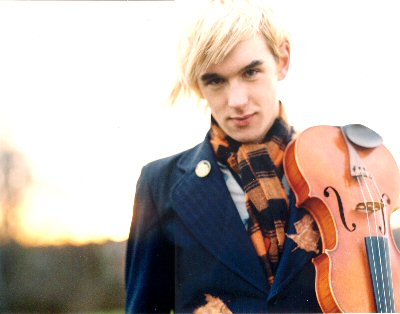
    Patrick Wolf is a flamboyant artist with an umbilical connection to London, who has managed to channel the spirit of the English Romantics to express the struggles of the modern bisexual generation.  The picture posted here is of Patrick at his most tame--other photos you might look up display him dressed up as airplanes, decked out in his signature "vulture cape," or strapped into S&M regalia. But letting his propensity for the shock factor scare you away would mean a definite loss--in his body of work, he is accomplishing something of literary proportions. 
   His music, which combines virtuoso singing, orchestration and instrumental

performances with electronic pop elements, somehow manages to come off sounding honest every time. His lyrics are charged with literary energy. Picking up on poetic images, like the reputation of magpies as thieves, he molds highly lyrical content, without any apparent effort, to his own original ends ("Magpie, was it you who stole the wedding ring? Or what other thieving bird would steal such hope away?").
    Wolf's second and third albums, "The Wind in the Wires" and "The Magic Position" represent him at his best. Plucked out of the London masses at a very young age, he was set up with mixing and recording equipment, and not long afterwords produced "Lycanthropy," which I think of as mostly juvenalia, but which set the stage for two undertakings that combine absolutely state-of-the-art mixing with world-class orchestration, almost all of which was recorded by Wolf himself. Indie fans might be interested to hear that his violin talents have been put to use by The Arcade Fire numerous times.
    The real genius of his work is his sensitivity to the lyric--like Shelly or Byron, he sets himself up as a kind of genius solitary, a wander and outcast whose rebellion against norms is a source of enlightenment. This strategy molds excellently to his own cause--the "satanist school" of the Romantics is morphed into a "transsexual school" of lyrical music which makes similar use of lonely contemplation, outdoor images, and, of course, shock value. Once Shelly denounced both Heaven and Hell in his epic, "Alastor," now Wolf seems to denounce sexual norms with equivalent flair and vibrato: "In the same way I don't know if my sixth album is going to be a death-metal record or children's pop," he said in an interview with The London Paper, "I don't know whether I'm destined to live my life with a horse, a woman or a man. It makes life easier." It's hard to imagine how that could make life easier at all, but Wolf's stance remains lucid. The confusion and rage he feels as a result of this stance is evident all over his work, and seems to have pushed him over the edge in his latest album, "The Bachelor," which is a descent into hammering, unpleasant techno-rock that I think displays all of his worst qualities and few if any of his best.
   One of my favorites of his is called "Magpie" (From "The Magic Position") a haunted piano piece in which a young boy lost in a sexual "hinterland" questions and is answered by a wise, thieving bird, who has stolen his wedding ring from him, a symbol of definitive sexual identity. Though he is often disagreeable and purposefully grating in interviews, in his best music you will fund lush, extravagant style that echoes something of Wilde in addition to everything else: Wolf's obsession with beauty is obvious, and in his highest moments he achieves the clearest, most winning expressions of sexual struggle produced by our generation. Similarly to Wilde's "The Love that Dare Not Speak its Name," his work tries to convince us of its rightness by virtue of its beauty, and almost does it. 


   Here's a great live version of "Magpie" http://www.youtube.com/watch?v=Y2tnRR6FJ5U